Those Grooves in Your Concrete Aren't Cracks — They're Control Joints
Control Joints and Why Kansas Slabs Need Them
Those straight lines across your driveway or patio aren't damage — they're control joints, and they're the reason a slab cracks where you want instead of where you don't. Kansas clay swells in a wet spring and shrinks in a dry August, and freeze-thaw tugs at the surface all winter. Concrete is going to move; joints just decide where it gives.
THE SHORT VERSION ON CONTROL JOINTS
Every slab cracks eventually — joints decide whether that's a clean hidden line or a jagged break.
On a 4-inch slab: joints no more than about 10 feet apart, cut a quarter of the slab's depth.
Timing wins it — we cut the same day we pour, before Kansas soil starts pulling.
WHY CONCRETE NEEDS JOINTS AT ALL
Concrete shrinks as it cures, and a slab with nowhere to release that stress cracks on its own terms. Add clay shifting underneath and the freeze-thaw cycles that hit Wichita all winter, and movement isn't a maybe — it's a certainty. A control joint is a planned weak point: you groove the surface, and the crack forms down in that groove, straight and hidden, instead of wandering across the finish.
Spaced too far apart, or skipped, and the slab picks its own crack line.
CHECK YOUR SLAB'S JOINT SPACING
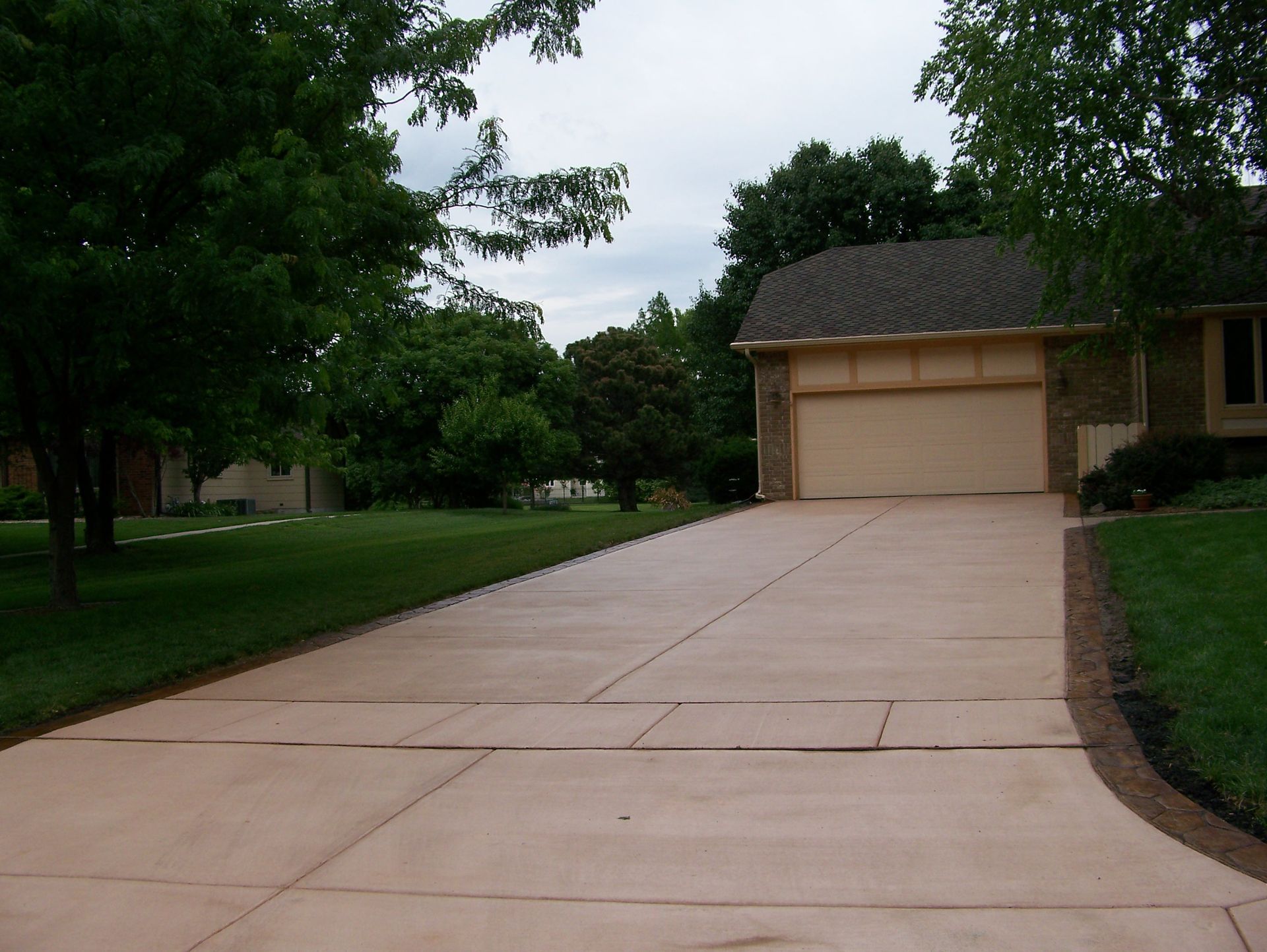
Measure between the grooves on your driveway. On a 4-inch slab, much past 10 feet apart is asking for a random crack, and no joints at all on a big slab is a red flag.
Before you pour, get a second set of eyes — if a bid doesn't mention jointing, call 316-945-3232 and we'll tell you what that slab needs.
WHERE JOINTS GO AND WHEN WE CUT
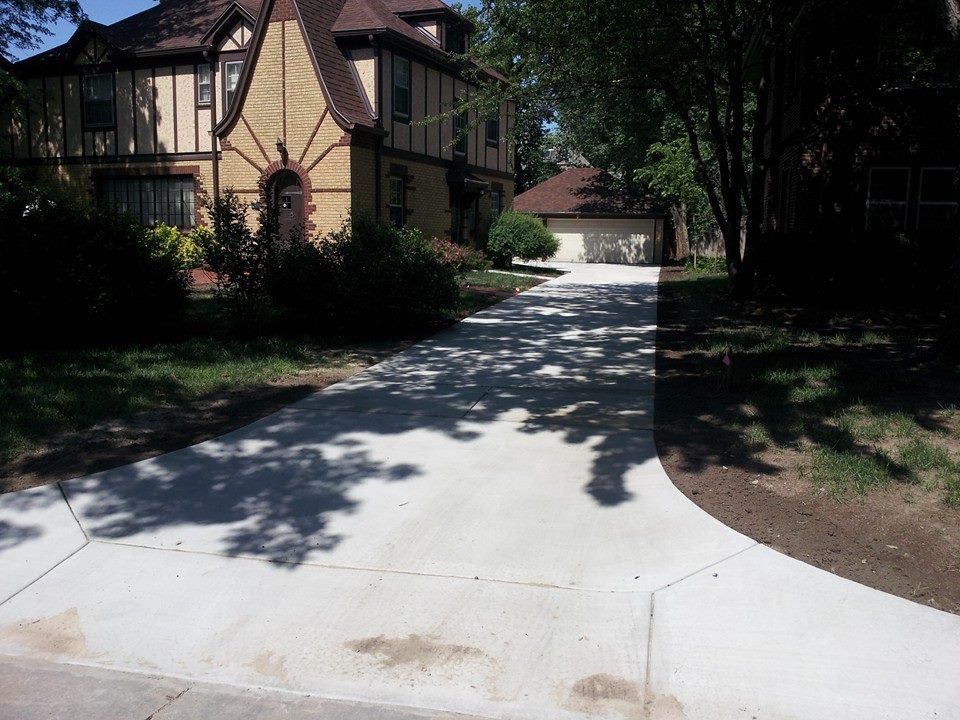
Joint placement is a layout decision we make before the truck shows up. Joints run roughly square — a long, skinny ribbon cracks worse than a tidy grid of panels — and they line up with inside corners, where stress concentrates. Where the slab meets your house or garage, we add an isolation joint so it can move without dragging the fixed structure along. Depth matters too: a joint has to reach about a quarter of the way down, or the crack ignores it.
Keep panels close to square, and cut a full quarter-depth — a shallow scratch does nothing.
WALK YOUR DRIVEWAY FOR TROUBLE SIGNS
Look for cracks running off the joint lines, panels longer than they are wide, or a slab butted tight against the garage with no gap. Any of those means the jointing came up short.
Not sure if it's cosmetic or structural? Email a photo to office@bnbbuilders.com and we'll tell you straight.
FROM THE FIELD
On a typical 4-inch driveway, we cut joints no more than about 10 feet apart and a full inch deep, the same day we finish — before the slab sits overnight. Wait too long in Kansas and the clay starts moving before the joint is in, and you've lost the race. On the heavier clay lots past the edge of town, we tighten the spacing, because that ground moves more. Nearly every cracked-slab callback we get traces to the same thing: a slab with no joints, or joints cut too shallow and too late to matter.
JOINTS ARE CHEAP INSURANCE FOR CONCRETE
A control joint costs nothing but a plan and a saw pass, and it's the cheapest thing standing between your slab and a random crack. Done right, it's a detail you never think about again. Skipped, it's why you're pricing a tear-out in a few years.
P.S. — Pouring a driveway, patio, or slab this winter, or planning one for spring? Get a free estimate from a crew that handles every step in-house. Call 316-945-3232 (Wichita) or 913-453-3232 (Kansas City), or visit bnbbuilders.com.
Share this article: